Keep Kids Learning with Summer Eco-Activities
The academic year may be ending soon, but education doesn’t have to stop at the school gates. Over the summer, your children have endless opportunities to expand their knowledge of the world around them, whether their interests lie in climate change, waste reduction, ecosystems, or all of the above.
Packing the whole family up for an outdoor excursion can be a hassle. Resources may be limited, but in this blog, we will outline just a few of the many activities that can be done completely at home with materials you most likely already have.
Review KPB’s Online Resources
Complete our environmental leadership course. Suited for middle and high school students, this online course provides students with the skills necessary to become stewards of their local environment. Sessions include learning about watersheds, environmental health, community beautification, virtual tours, online games, and more. You can find an interest request form here.
Take part in our Kids Can Tic-Tac-Toe project. Designed for preschool through elementary schoolers and their families, kids will complete a minimum of three activities, document their results, and email them to us. In return for completing the project, your kids will receive a prize! More information is available here.
Take an Environmentally Conscious Tour of the House
Before you begin the tour, take some time alone to think about how your household uses energy, water, and other limited resources. This way, you can drive home the concepts that would really make a difference for your family and in your everyday life.
To begin the tour, tell the child to enter each room and brainstorm how a daily activity impacts the environment. For example, when they enter the bathroom, ask what the difference is between keeping the faucet running while they brush their teeth versus waiting to turn it on until it's time to rinse. Explain why the difference is relevant.
Include other examples that emphasize environmentally conscious behavior, such as turning off lights when leaving a room and drinking tap water instead of a single-use bottle. Teach them how these actions can help protect the environment and the things they care about, such as their favorite animal.
Conduct Science Experiments
If your child is more interested in hands-on activities, there is a plethora of at-home science experiments available online. Many use products you likely already have sitting at home.
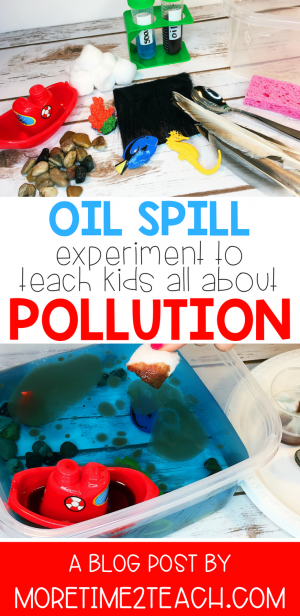
One such experiment is an Oil Spill Simulation. In this activity, you will use a tub of water and a dark colored liquid to represent ocean pollution. Your child will be tasked with removing the dark liquid from the water. Once your child realizes they can’t clean the water, you relate the activity back to real-world oil spill disasters. A similar experiment that incorporates plastic marine debris can be found here.
Your child might be more interested in natural processes rather than threats. If that’s the case, teach them about the ocean’s zones by making them in a jar. Using substances that naturally separate and some food coloring, your kid can learn all about the layers of the ocean and the animals that live there. This activity can be easily modified to teach about the Earth’s atmospheric layers instead.
Calculate Your Family’s Carbon Footprint
There are many resources available that can help your family better understand your impact on the environment. One such resource is referred to as a carbon footprint.
By taking a short quiz, you can learn where your family produces the most waste, how to reduce or offset that waste, and what the average consumption is in your area. Filling out the quiz with your child present can lead to an in-depth conversation about how your family can make your lifestyle more sustainable.
There are also water consumption calculators. This calculator will teach you about a different but equally important source of waste in your household, and how you can reduce such waste.
Watch an Environmentally Themed Movie or Show
Every article on the subject will tell you that WALL-E and The Lorax are great movies to teach kids about environmental issues. That’s true! However, there’s a ton of equally impactful environmental media that goes overlooked.
Some movies for younger kids include Over the Hedge, Rio 2, and Dolphin Tale. Older kids may better appreciate PG-13 movies, including The Day After Tomorrow, Princess Mononoke, and Avatar (2009), along with their sequels.
Regardless of age, documentaries are an amazing source of learning. Some diverse topics include Our Planet, March of the Penguins, and Fantastic Fungi.
Most streaming services have dedicated sections for documentaries, so browsing to find more should be easy. As you choose, however, pay attention to the audience ratings. Some environmental documentaries show very upsetting images of animal harm, which are not suitable for younger children.
We hope these recommendations make your family’s summer months more engaging and less stressful. These learning activities not only teach your children about important environmental topics but also teach you along the way. We hope we’ve shown you that family fun doesn’t have to be locked behind far distances or pricey supplies, and our suggestions aren’t the only ones out there!